D-Jetronic
History and Fundamentals
History
The D-Jetronic system developed by Bosch in the early 1960's was the first
mass-production electronic fuel injection system. It was
primarily based on patents that Bosch licensed from the Bendix corporation.
Bendix developed the basic idea of using an inductive element coupled to
manifold vacuum as a component in a loop circuit ("multivibrator") to
develop the basic
injection pulse width. The system was first used on the 1967 VW Type 3 motors.
Bosch continued development of the system, and it was last used in the
D-Jetronic form in about 1976. Variants of D-Jetronic were used by other
manufacturers (Ford, Toyota, etc.) for many years, and various forms of
"speed-density" injection systems similar to D-Jetronic are still in use today.
Bosch developed many more types of electronic fuel injection after
D-Jetronic (L-Jetronic, K-Jetronic, etc.) that had improved characteristics, and
still is a dominant force in fuel injection systems today.
D-Jetronic
References
Two papers were published in the Bosch Technical Journal that gave overall
descriptions of the D-Jetronic system, components, and operation. I have
recently secured these documents from the Bosch archivist and there are links
below to the PDF files. Both articles are in German. I have done a rough
translation of the Scholl article that is in text file format. The system as
described in the Scholl article is very similar to the implementation of
D-Jetronic on the Porsche 914 1.7 and 2.0L motors.
"An Electronic
Fuel Injection System for Automobiles", Von Gunther Baumann, Bosch Technical
Journal, 1967.
"Electronic Fuel
Injection - Jetronic", Von Hermann Scholl, Bosch Technical Journal, 1969
(part 1)
"Electronic Fuel
Injection - Jetronic", Von Hermann Scholl, Bosch Technical Journal, 1969
(part 2)
English
Translation
D-Jetronic
Patents
Thanks to Dirk Wright, 914 owner and USPTO employee, I have a good list of
fundamental D-Jetronic related patents, and I've found quite a few using those
as a starting point. Here are links to the patents at the USPTO web site, along with a short description of the gist of each patent. NOTE
- you may have to load the TIFF file applet to be able to view and print the
patents, click on any of the patents below and follow the "Help" link for more
information. If anyone can dig up patents on other D-Jetronic components, please let me know and I'll include
the numbers here.
UPDATE: The USPTO has changed its URL format since I first wrote this
document. To avoid issues in the future with changing URL's, I'm only going to
list the base URL for the USPTO search page below:
http://patft.uspto.gov/netahtml/PTO/patimg.htm
Copy the patent number from below that you want to see, then click the link
above. Enter the number, then click on the "Images" button at the top of the page to see the patent....
- 2,948,272 - 9/2/1960: Bendix FI system patent that D-Jetronic is based
on.
- 2,992,640 - 7/18/1961: Early Bosch EFI patent. Note the use of the loop
circuit and inductive pressure sensor.
- 3,005,447 - 10/24/1961: Much more evolved Bosch EFI patent by Gunther
Baumann. Note dual-coil pressure sensor, speed correction, loop circuit,
etc., very much like D-Jetronic.
- 3,338,221 - 9/29/1967: Fundamental D-Jetronic patent by Hermann Scholl
of Bosch. Similar to the Baumann patent, but with full ECU for mixture
control, temperature compensation, speed correction, starting enrichment,
etc.
- 3,452,727 - 7/1/1969 : Early MPS patent
- 3,463,130 - 9/26/1969: D-Jetronic with over-run shut-off circuit from
Bosch.
- 3,464,396 - 9/2/1969: D-Jetronic variant with a differential MPS
- 3,483,851 - 12/16/1969: Another D-Jetronic variant from Bosch.
- 3,490,424 - 1/20/1970: Dual aneroid cell version of the MPS similar to
production model
- 3,521,606 - 7/28/1970: Overall structure of the ECU, with focus on the
speed control circuit
- 3,570,460 - 3/16/1971: Improved over-run shut-off circuit. Used on the
1975-1976 Porsche 914 2.0L ECU (0 280 000 051)
- 3,583,374 - 6/8/1971: Full-load diaphragm version of the MPS
- 3,593,692 - 6/20/1971: TPS and ECU acceleration circuits
- 3,620,196 - 11/16/1971: Speed control circuit of the ECU
- 3,623,461 - 11/30/1971: Pulse multiplier circuit of the ECU? Speed
control? (needs review)
- 3,651,791 - 3/28/1972: Nippondenso patent on a MPS very similar to the
FL diaphragm Bosch MPS, but with port for induction pressure
- 3,678,904 - 7/25/1972: Injector driver circuit of the ECU
- 3,734,067 - 5/22/1973: Starting enrichment circuit of the ECU
- 3,747,575 - 7/24/1973 Load-dependent speed control circuit of the
ECU (adaptation)
"Speed-Density"
Fuel Injection
NOTE: The discussion here is limited to constant fuel pressure, multi-port,
pulsed injection systems.
The primary function of any injection system is to control the mass air/fuel
(A/F) ratio of a specific engine over all expected operating conditions. The
desired A/F value for a specific operating condition depends on the optimization
of fuel economy, performance, emissions, and other factors. The parameter that
is to be controlled is the mass of fuel to be injected, so the problem is to
determine the mass of the air in the cylinder. A "speed-density" system does
this by measuring the density of air in the intake manifold (via a
pressure or vacuum sensor), correcting for the pumping efficiency of the engine
(which is a function of engine speed). The result gives the density of
air in the cylinder. If the cylinder volume is known, then the mass of the air
in the cylinder can be determined. Since the fuel pressure and flow rate of the
injector is also known and constant, the exact pulse duration to deliver a fuel mass needed
to produce the desired A/F value can be determined.
In the D-Jetronic system, the manifold pressure sensor senses the intake
manifold vacuum, and engine speed is sensed by the trigger contact points in the
base of the distributor. The contact trigger points also determine the timing of
the injection pulses. D-Jetronic is a grouped injection system, where half of
the injectors are in a group that are pulsed simultaneously. In four-cylinder
implementations, there are two cylinders per group. There is one injection pulse
per power cycle. With grouped injection, one cylinder gets the injection pulse
right before the intake valve opens, the other cylinder gets the injection pulse
about 180 degrees before the intake valve opens.
Below is a plot of data taken on a 2.0L Porsche 914 D-Jetronic system under
simulated operating temperature, engine load, and engine speed conditions using
an EFI Model 1401 Electronic Analyzer, a D-Jetronic tester:
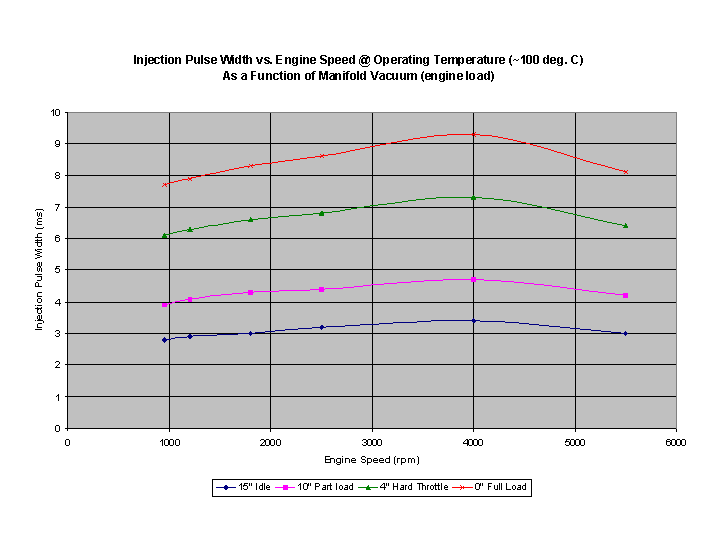
The speed-density nature of the system is obvious from this plot. As engine
load increases (decreasing manifold vacuum), the injection pulse width increases
(the "density" part). At a constant load, injection pulse width varies with the
pumping efficiency of the motor (the "speed" part).
The total pulse duration described above determines the "basic injection quantity",
or Tb. Other factors must be accounted for to determine the actual injection
pulse, Tinj. These factors include:
- Air Temperature: The density of air is a function of temperature
and the basic injection quantity must be corrected for the effect. In the
D-Jetronic system, the TS1 sensor is a negative-temperature-coefficient
resistor (resistance goes down as temperature goes up), mounted on the intake
plenum. The ECU uses the value of the TS1 resistance to correct the injection
quantity for the effect of temperature.
- Acceleration: Due to the finite response time of the pressure sensor and
the ECU, and the inertia of the air mass in the intake manifold, there is a
delay between the opening of the throttle and the response of the system to
the need for added fuel. To reduce this response time, a separate acceleration
system is required for good engine response. D-Jetronic uses a set of contacts
in the throttle position switch to provide both
immediate injection pulses and a temporary acceleration enrichment effect when
the throttle is opened.
- Idle: For good transition when accelerating from a stop,
low emissions, and for smooth
and stable idle while powering accessories (e.g. lights, cooling fan, a/c,
etc.), control over the idle mixture is required. In D-Jetronic, an idle
switch on the throttle position switch sends a signal to the ECU when the throttle is closed. A
separate idle mixture control circuit in the ECU sets the idle mixture, which
is adjustable via an external potentiometer.
- Cold Starting: When the engine is cold, additional fuel is required for
starting due to poor mixing and condensation of the A/F mixture on cold
intake, cylinder, and piston surfaces. The ECU senses the cold start with
the engine temperature sensor, TS2, and provides
additional fuel when cranking. At temperatures below 32 deg. F ("Cold-Cold
Start") , a
separate thermo-switch and cold-start valve (CSV) in the intake manifold are
activated. This injector sprays a fine mist of fuel into the intake system that mixes
better with the cold air than the injector spray, and helps make cold starting
easier. Some later D-Jetronic systems used a thermo-time switch which limited
the duration the CSV would remain open, to prevent flooding and spark plug
fouling.
- Warm-Up Transition: When the engine is below its normal operating
temperature, more fuel is needed to account for condensation and incomplete
mixing until the engine is fully warmed up.
Engine temperature is sensed by the TS2 sensor. The ECU has a warm-up enrichment circuit
that senses the resistance of the TS2 sensor and corrects the mixture for the engine temperature.
When the value of TS2 drops below a threshold value (typically 300 ohms),
the warm-up circuit in the ECU has a cut-off characteristic, so that no
additional decrease in TS2's resistance will affect the mixture (i.e. the
engine is fully warmed-up).
- Over-Run: When the throttle is closed while the car is moving and
in gear, there is a high vacuum in the intake manifold while the engine is at
a fairly high speed. For lower emissions, early D-Jet system shut off the fuel
supply until the engine had dropped below some target speed (1300 rpm or so).
Over time, this was found to increase HC emissions when the fuel supply was
restarted, due to cooling of the cylinder walls, and the over-run circuit was
deleted from the ECU. Surprisingly, later cars (1975-1976 2.0L) have ECU's
where this circuit was restored, possibly to reduce unburned fuel from being
passed through the exhaust to the catalytic converter, which can cause the
temperature of the converter to rise to dangerous levels. On some cars, an air bypass valve (deceleration valve) was incorporated
that passes additional air past the throttle plate when closed, to provide
better combustion during over-run.
- Full-Load: When the engine is under full-load (wide open throttle)
conditions, maximum power is required and an enriched mixture is needed.
Additionally, air cooled engines under full-load conditions need the
additional fuel for cooling. A full-load diaphragm is
incorporated into the manifold pressure sensor to enrich the mixture under
full-load conditions. This diaphragm is activated when the pressure
differential between the intake manifold and the atmospheric pressure drops
below 100 mTorr. The diaphragm moves more per unit pressure difference than
the part-load aneroid cells, causing an abrupt increase in the injection
duration.
For a detailed description of how the ECU operates and accommodates the
various operation conditions, see my
ECU web page. For a
detailed description of how the manifold pressure sensor responds to part-load
and full-load conditions, see my
manifold pressure sensor web page.
D-Jet System
Engineering - My Conjectures...
Bosch used D-Jetronic for many different applications. Here are a few
conjectures of mine as to how they made the system manufacturable by using
standard components and customization:
Flaws
Both of these issues are specific to air-cooled
D-Jetronic applications (VW and Porsche)
- Lean Warm-up Mixture: VW and Porsche 2.0L
applications suffer more from this problem than the 1.7L, which may be an
oversight on the part of Bosch as to the additional fuel requirements of the
2.0L. For the first 10-15 minutes of operation, the value of TS2 is too low
to provide a rich enough mixture for good operating characteristics.
Symptoms include rough and/or low idle, surging under steady light throttle
loads, and intake popping during over-run. The "old school" way to fix this
problem was to add series ballast resistance to the TS2 sensor to richen the
mixture. Unfortunately, the amount of correction required to get the mixture
right is often greater than ~200 ohms. Addition of this much resistance
causes the ECU to never sense that the car is fully warmed up, leading to
mixture instability and poor running. The factory eventually recognized this
problem, and developed a spacer to fit between the TS2 sensor and the
cylinder head. This spacer delays the heating of the TS2 sensor, effectively
enriching the mixture. Reproduction spacers can be obtained from Brad Mayeur
(google him) or you can fabricate your own, with instructions on my
parts page.
- Rich Warm Start Mixture: The symptom here is
that after the car is fully warmed-up, you stop for 10-15 minutes to go into
a store. When you return and try to start the car, it won't start until you
open the throttle significantly, and the car runs poorly for the next few
minutes after starting. If instead of waiting 10-15 minutes, you wait 30+
minutes, the car starts and runs without problem. This behavior is caused by
the differential cooling rates of the aluminum heads and the cast iron
cylinders and pistons. The heads cool much more quickly, so the value of TS2
increases in response, telling the ECU to deliver a richer mixture. However,
the cylinders and pistons are still quite hot, and don't require such a rich
mixture, causing poor starting. After the motor runs a few minutes, the
heads heat back up and proper mixture is restored. If you wait 30+ minutes,
both the cylinders and pistons cool off as much as the heads, and the car
starts properly. To improve warm starting, try depressing the throttle
BEFORE turning the key, to avoid spraying additional fuel into the intake,
due to the action of the accelerator circuit traces in the throttle position
sensor. Also note that the addition of a TS2 spacer on the 2.0L engines to
fix the lean warm-up mixture problem described above, may make the warm
start problem worse, as the TS2 sensor will cool even more rapidly.
Back to home